A polished submission doesn't prove your students understood the work. Here's how to make sense of homework in the AI era by checking reasoning, not policing AI.

Jovi Maniago
Head of Marketing at Better-ed

Your students submit neatly written essays, clean lab reports, fully worked problem sets. On the surface, everything looks right. And still, the same quiet question sits with you while you mark: do they actually understand what they turned in?
That question is not new. What has changed is how easy it is to hide the answer. Tools like ChatGPT and Gemini can now produce polished work in seconds, and student use is climbing fast. One national panel found the share of students using AI for homework jumped from 48 to 62 percent in a single year, with most of those same students worried it was eroding their own critical thinking. A finished assignment was never perfect proof of learning. Now it is even less reliable as evidence.
Picture a senior high science class. A student hands in a report on Newton's Laws: graphs, calculations, a tidy explanation. It reads beautifully. Then you ask them to walk you through why they set up the computation that way, and the explanation falls apart.
That gap has a name worth saying out loud: output is not the same as understanding. Traditional grading rewards correctness, format, and completeness. It rarely shows you reasoning, articulation, or whether a concept actually landed. As Fortune recently put it, AI now generates submissions that look accurate and complete, which makes it harder than ever to tell whether a student understood the material or simply prompted for it. This is the same problem we unpack in why a correct quiz answer can't tell you what your students really understood. Homework just raises the stakes, because the misconception can travel home, get polished, and come back invisible.
The instinct is to reach for a detector. It's understandable. It also doesn't hold up. The same reporting found that AI-detection tools misfire about as often as they work, and other studies have flagged non-native English writing as AI-generated at alarming rates. For Filipino classrooms where students naturally answer in Taglish, that false-positive risk is not hypothetical, it's a fairness issue.
Chasing detection also aims at the wrong target. Even a perfect detector would only tell you whether a tool was used. It would tell you nothing about what the student can actually explain, defend, or apply. And it turns the classroom into a place of suspicion, which is the opposite of what makes students want to think out loud.
So the more useful question is not "did AI write this?" It's "can this student explain it?" That reframing is what makes homework in the AI era workable again.
Here is the shift that actually moves things forward. Instead of treating homework as a final checkpoint, treat it as the start of a short conversation.
After a student submits, they answer a few follow-up questions about the same work, in their own words. An essay on climate change becomes a two-minute prompt: explain why greenhouse gases trap heat, or what alternative did you consider, and why did you rule it out? A worked equation becomes: why did you isolate that variable first?
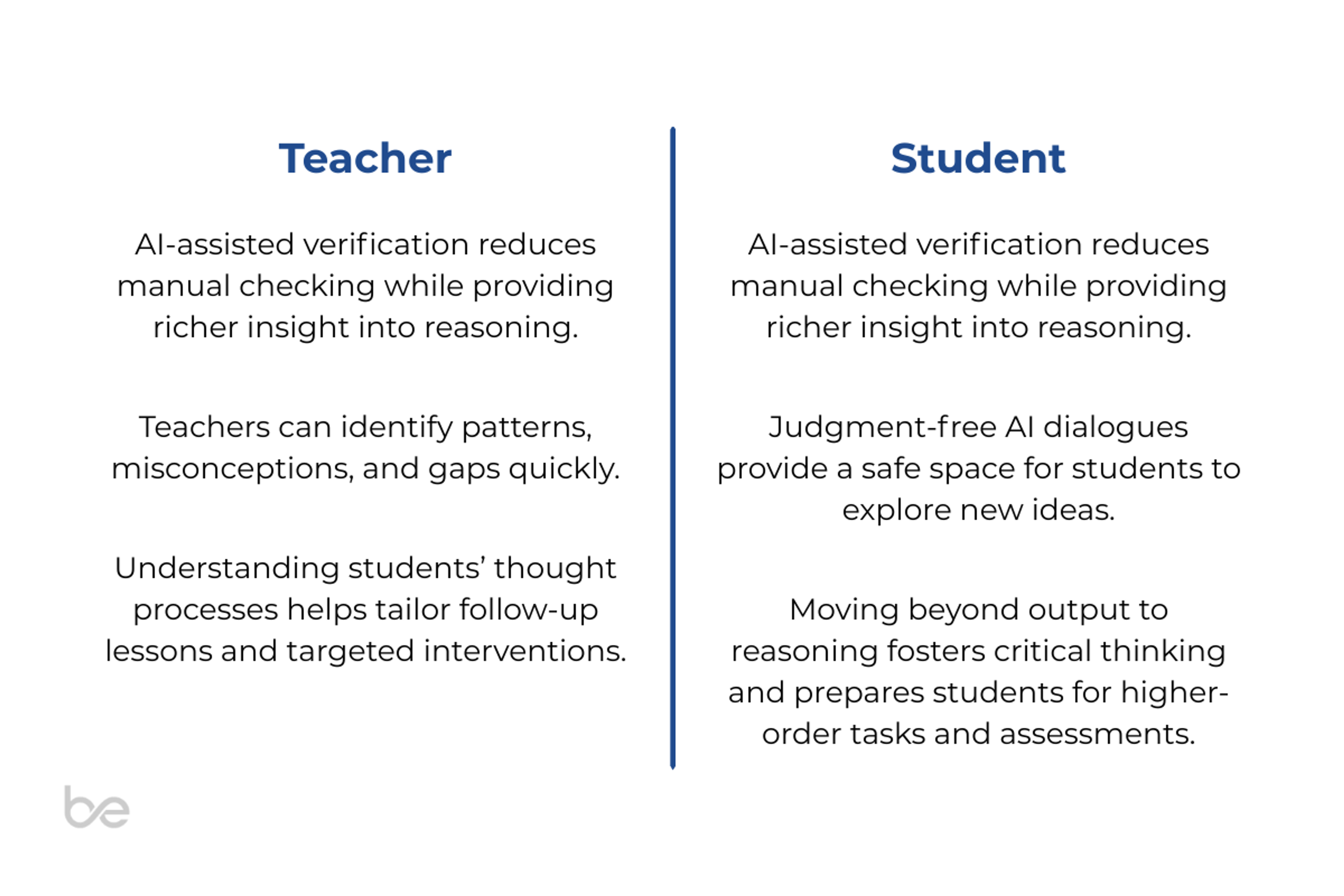
Three things happen when you do this:
This is the practical core of AI formative assessment done well: it strengthens feedback and keeps you firmly in control, rather than handing judgment to a machine. It also pairs naturally with designing tasks that reveal real thinking instead of rewarding recall.
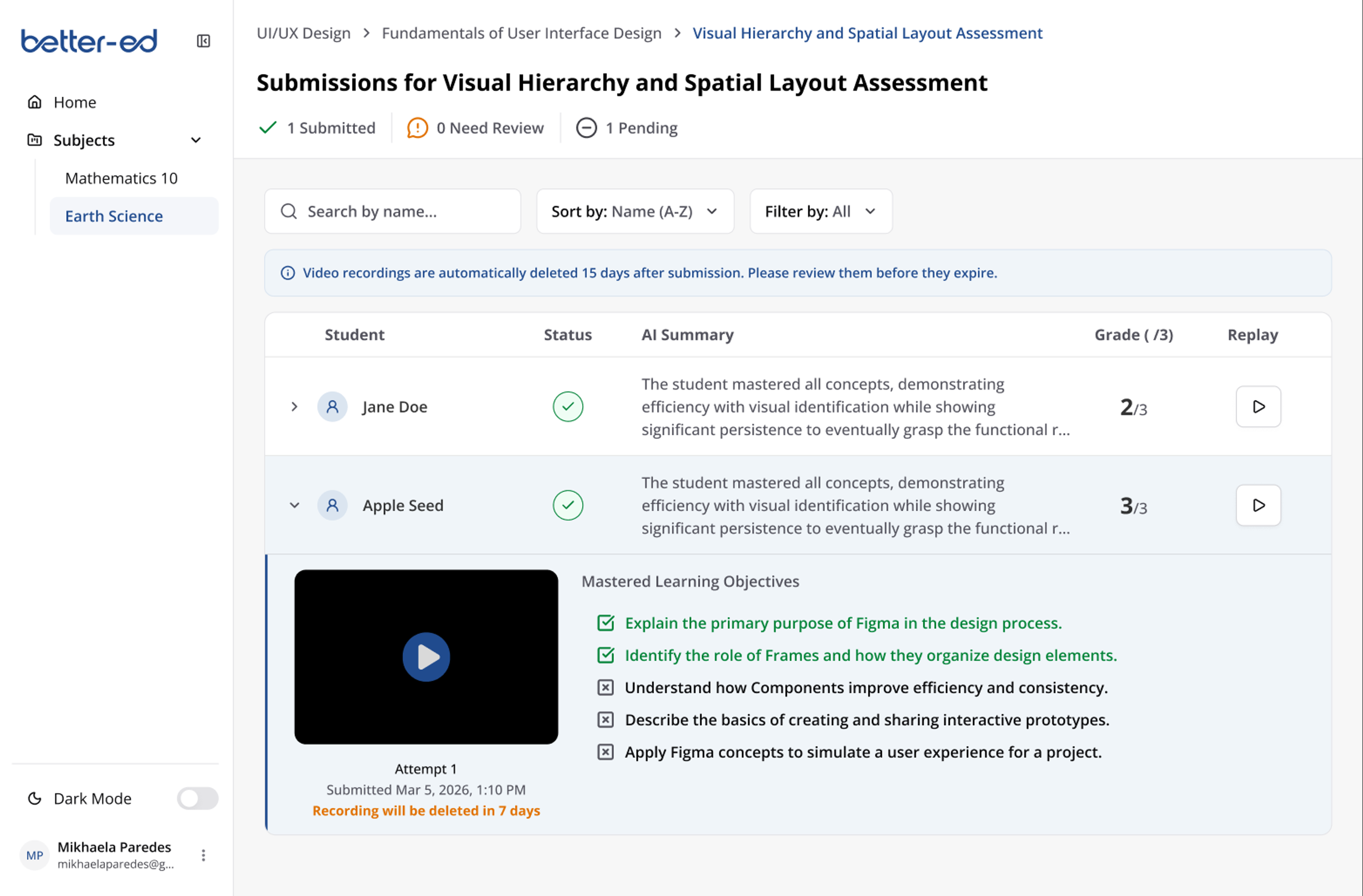
A conversation captures things a grade never will. When students explain their reasoning, you can see whether they understand the underlying concept, whether they can justify their steps, and where the logic quietly breaks. You also hear the students who rarely raise a hand in a full classroom, which makes this a quiet win for equity, not just integrity.
This is not a new idea for great teachers. It's the logic behind oral defense, the follow-up question, the "explain it back to me" that experienced educators have always trusted. Schools piloting this see it play out in practice. Barcelona Academy uses voice-based oral assessment to hear how students actually reason through a lesson, turning limited class time into real insight. The only thing that's new is being able to do it for a whole class without staying up until midnight grading.
The point of homework was never the paper. It was the thinking the paper was supposed to represent. AI didn't break that. It just made the shortcut too easy to ignore, and forced a better question.
The future of homework is not policing AI or grading faster. It's making sure every student can explain, reason, and show understanding in their own words. When homework becomes a dialogue instead of a checkpoint, learning gets iterative, honest, and visible again. And you spend your time where it counts: teaching the ten students who need it, not re-reading the thirty who don't.
———
Prove your students understand. better-ed turns any lesson into a short conversation where students explain their answers in their own words, and gives you the misconception insights without the manual grading. Try it free.
