DepEd Order No. 003, s. 2026 asks Filipino learners to disclose their AI use. A story out of Brown University shows what happens when nobody checks.

Jovi Maniago
Head of Marketing at Better-ed
For nearly two decades, Roberto Serrano taught the same advanced economics course at Brown University. Enrollment usually topped out around 30 students. Midterm averages landed somewhere between 65 and 80.
This spring, things changed. After a shooting on campus in December left students anxious about sitting exams in crowded rooms, Serrano moved the midterm and the final to a take-home format. Word got around. Enrollment jumped to 86.
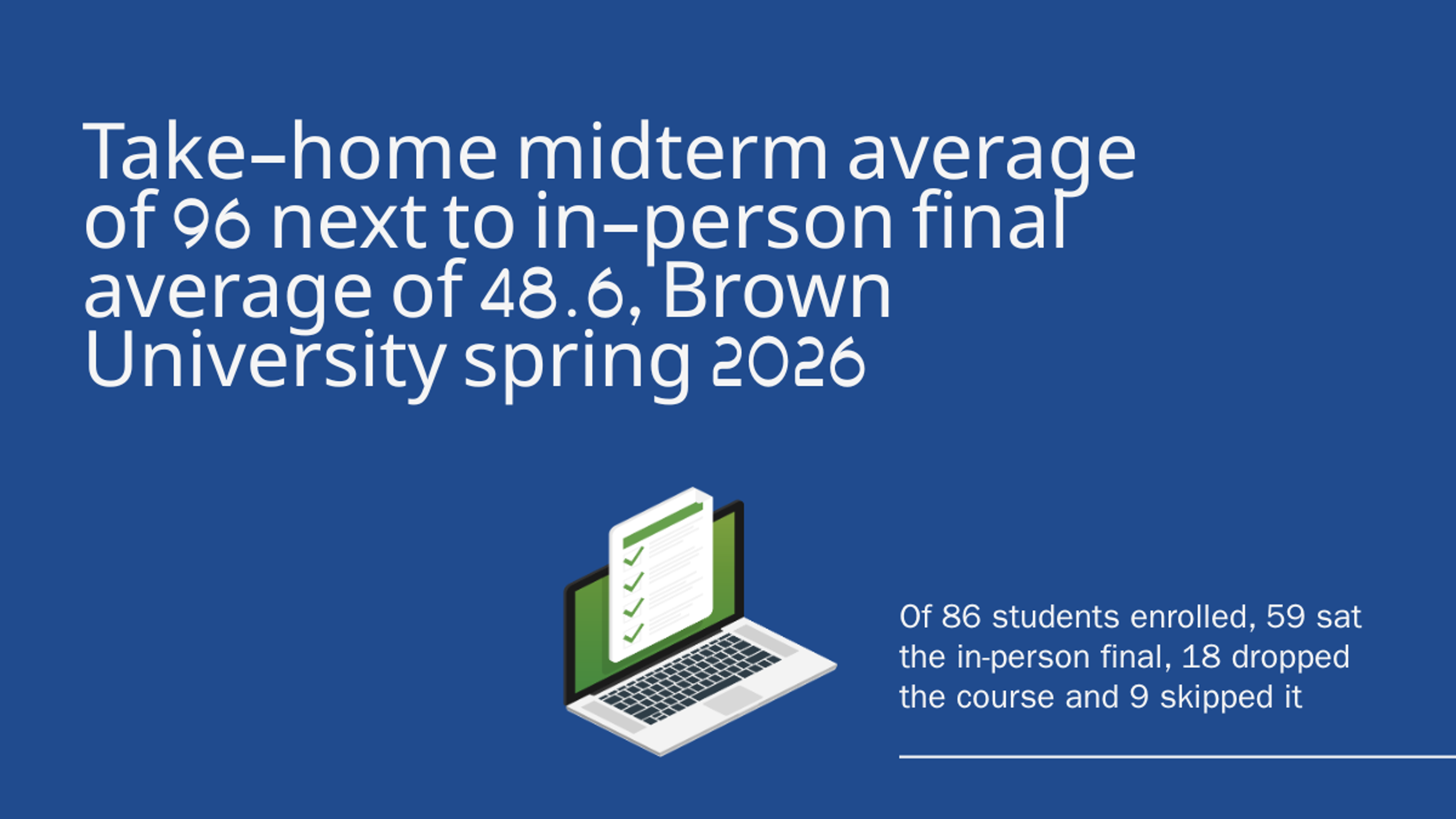
The midterm average came back at 96. Forty students scored perfect.
Serrano had taught this material long enough to know that was not possible, so he ran his own exam questions through ChatGPT. The chatbot mostly answered correctly, though it produced a few odd responses along the way. Those same odd responses turned up in student papers.
He told the class the final would be held in person, and that he would void the midterm if the two score distributions did not match. Eighteen students dropped the course. Nine stayed enrolled and skipped the final anyway. Of those 27 students, 22 had earned a perfect score on the midterm.
The 59 who sat the in-person final averaged 48.6, the lowest result in the history of the course.
Fifty points separate what the take-home papers claimed and what the students could actually do.
That gap is worth sitting with, because what failed here was the measurement itself. The 96 described what a chatbot produces when pointed at a set of exam questions. That is a fact about the chatbot. It was never information about what the students had learned.
Assessment works on one quiet assumption: that the output in front of you is evidence of a process that happened inside a student's head. Take-home work carried that assumption safely enough for a long time. It stopped carrying it faster than most assessment design could adjust.
In February 2026, DepEd released Order No. 003, s. 2026, the first comprehensive guidelines on AI use in basic education. The policy takes a sensible line. It does not ban AI. It asks learners to disclose it: name the tool, explain how it was used in brainstorming, writing, research, presentations, homework support. Secretary Angara described it as graduated, with more independent learners given more latitude.
It is a good policy. It also quietly hands the verification job to teachers.
Picture what that means for a Grade 8 teacher carrying five sections. Performance tasks, written outputs, projects, most of it produced outside class hours, all of it now requiring a judgment call about whose thinking is actually on the page. Detection software is unreliable and occasionally accuses honest students, which is its own kind of damage. Reading closely enough to catch a mismatch takes hours that do not exist in a teaching load.
So the realistic outcomes are two. Teachers grade outputs they privately doubt, or they pull everything back into class hours and lose the assessment types that measure research, application, and extended reasoning.
Serrano's in-person final worked beautifully as a diagnostic. As a permanent design, it costs something real.
There is one thing a chatbot cannot hand a student: an unrehearsed explanation of their own reasoning.
A student who copied an answer can reproduce the answer. Ask why the second step follows from the first. Ask what would change if one value were different. Ask them to explain the same idea the way they would to a seatmate who missed the lesson. The gap surfaces on its own, without accusation, without software, without a confrontation that damages the relationship.
Every experienced teacher already knows this. It is what you do when a paper feels off, and it works. What has never been available is a way to do it for 200 students in a week.
We build AI tools, so this is an awkward story for us to tell. We think it is worth telling anyway, because the useful lesson in it is a narrow one. A finished answer stopped being sufficient evidence on its own. What carries the evidence now is the reasoning behind it.
That is what better-ed is built around. Students explain their answers in their own words, in a conversation. Teachers get the reasoning back, organized and readable, without grading every response by hand. When a student understands, you can see the shape of how they got there. When they do not, that shows too, early enough to actually teach into it.
Serrano got his answer by scheduling a second exam and watching a third of his class disappear. Teachers should be able to find out sooner, and with less cost to everyone involved.
better-ed is free for teachers. Sign up with your Google account and see how your students think.
